

Responsible gambling: keep play a choice
Gambling is entertainment with a real risk of loss, not a source of income. This page helps you set limits before you play, notice when habits shift and know which tools and support to use.
Reading your own signals: green, amber, red
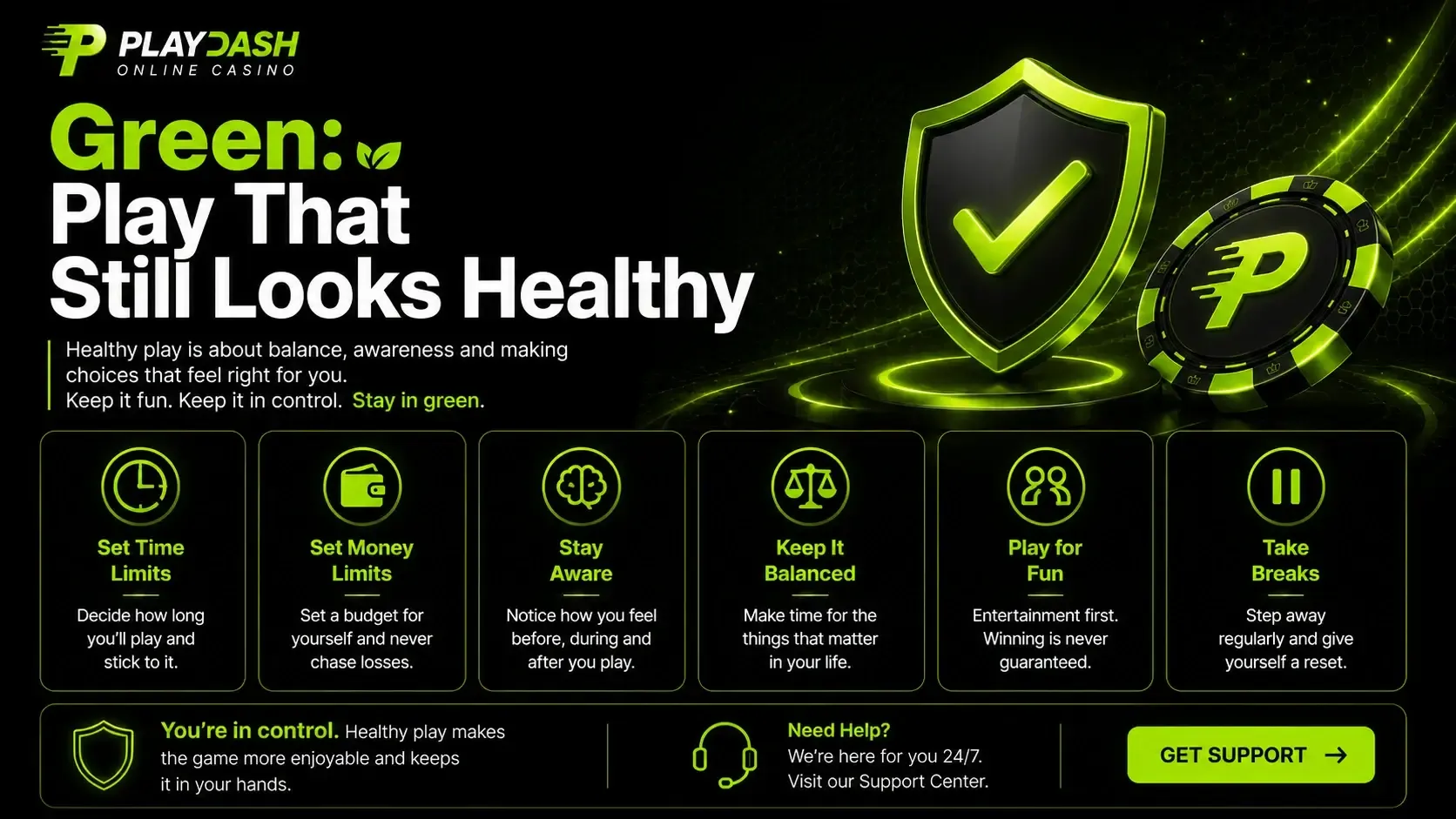
Control can slip gradually. A simple three-zone check makes the change easier to see.
| Zone | What it usually looks like | Sensible response |
|---|---|---|
| Green | Budget and time limits stay intact | Keep the boundaries in place |
| Amber | Spending, time or mood begin to shift | Reduce access and reassess habits |
| Red | Control is repeatedly lost | Use stronger limits, a break or self-exclusion |
In the green zone, boundaries exist before the first bet. Money for entertainment is separate from rent, food, bills, savings and debt repayments, and time is planned rather than open-ended. A loss can be disappointing without creating an urge to win it back, and stopping at the planned point is still possible after a bad session.
Set money and time limits before you start
A budget does not need complicated maths. It needs a clear maximum that still feels acceptable if the whole amount is lost. The best moment to set it is before gambling starts, when decisions are not shaped by excitement or frustration.
- choose a fixed entertainment budget before opening PLAYDASH;
- use only disposable money — never rent, bill money or borrowed funds;
- decide in advance how long the session will last;
- set a stake limit for a single round;
- stop when either the money or the time limit is reached;
- never raise the next stake to recover an earlier loss.
Casino results are independent, so a losing round does not make the next one more likely to win. RTP and bonuses do not remove the chance of loss, and fast formats such as instant games simply let you spend faster.

Amber: the early warning signs
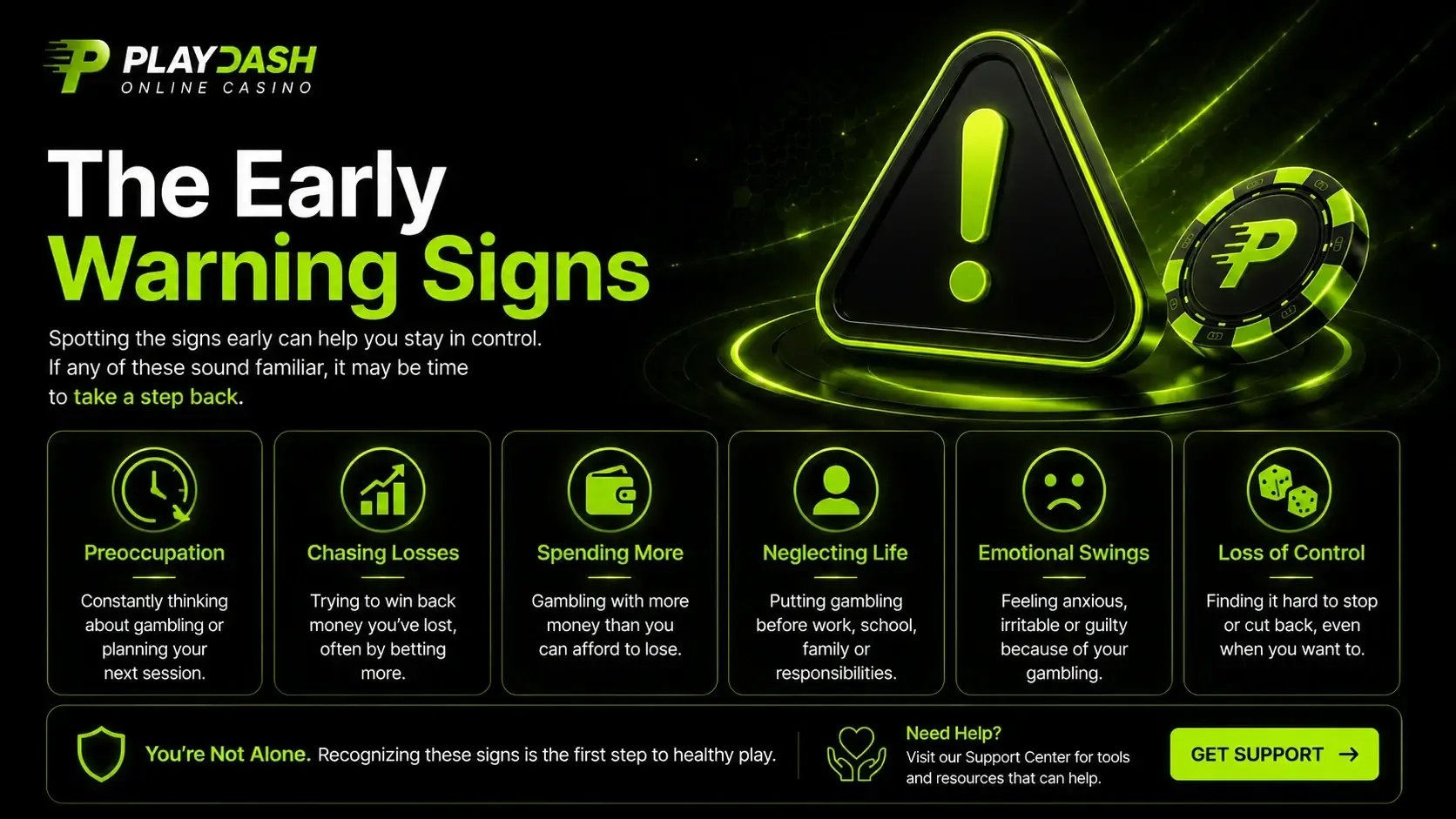
Amber does not mean gambling has already become severe; it means the pattern deserves attention. One unusual session tells you little. Several signs repeating together tell you much more, and cutting back early is easier than waiting.
| Signal area | Examples |
|---|---|
| Money | Larger or more frequent deposits, stakes creeping up, returning quickly after a loss to win it back, playing with borrowed money |
| Time | Sessions running past the planned stop, gambling more often than intended, sleep, work or plans slipping |
| Mood | Irritation when unable to play, anxiety about losses, guilt afterwards, playing mainly to escape stress |
| Secrecy | Hiding deposits, session length or losses from a partner, friend or family member |
Chasing losses deserves particular attention: returning to “get even” is widely recognised as a sign of problem gambling. A fair self-check is to compare the time and money you meant to spend last week with what you actually spent, using your transaction history.
Deposit limits, cooling-off and self-exclusion
When good intentions keep failing, practical barriers work better than willpower alone.
PLAYDASH’s confirmed account controls are deposit limits, cooling-off periods and self-exclusion. Each fits a different moment:
| Tool | When it makes sense | What it changes | Where to set it |
|---|---|---|---|
| Personal budget rule | Always, before play | Your own spending ceiling | On your own, in advance |
| Deposit limit | Spending is starting to rise | Caps how much can be added | In the account profile |
| Cooling-off | A short interruption is needed | Stops access for a defined break | In the account |
| Self-exclusion | Returning repeatedly is causing harm | Blocks betting, deposits and new accounts for the chosen period | Through operator support |
A deposit limit may be enough while other boundaries still hold. Cooling-off is stronger because it removes the immediate chance to continue. Self-exclusion is for when a short break or a spending cap no longer works.
How self-exclusion works
You request self-exclusion through the operator’s support and choose how long the break lasts. Open bets and the balance are settled first. For the whole period, betting and deposits are blocked and opening a new account to get around it is not allowed.
A self-exclusion period cannot be shortened once it has begun. That is deliberate protection against an impulsive return, and it is what makes the tool work. A return after it ends is at the operator’s discretion rather than automatic. Choosing a length with room to spare is wiser than picking the shortest option.
Exact durations, and whether the account history or support stay reachable during the break, are not published consistently. Ask support about both — and about any active bonus — before you submit the request.

Putting the tools to work
The tools work best when they back up limits you chose while thinking clearly, not when they are switched on after control has slipped.
- Before your first deposit, set a monthly entertainment budget from money left after rent, bills, savings and debt repayments.
- Set a deposit limit in the account profile that matches that budget; it is available from registration.
- Decide a session length and a stake per round, and stop when either limit is reached.
- Once a week, compare your transaction history with the plan.
- If you go over the plan, or catch yourself negotiating with it, take a cooling-off break in the account.
- If limits and breaks keep failing, request self-exclusion through support or live chat and choose a period with room to spare.
Before requesting self-exclusion, ask support what happens to open bets, the balance and any active bonus, and whether account history stays reachable during the break. Settling these first means the decision does not have to be reopened later.
Matching the response to the situation
| Situation | Zone | Practical response |
|---|---|---|
| You topped up again after the planned budget ran out | Amber | Stop for the day and lower the deposit limit |
| A session ran well past the time you planned | Amber | Fix a session length before the next login; use cooling-off if it repeats |
| You raised stakes to win back a loss | Amber | End the session — chasing losses is a recognised warning sign |
| You hid spending or playing time from someone close to you | Amber to red | Tell one trusted person and review the last month of transactions together |
| Limits and breaks have failed several times | Red | Request self-exclusion and contact a helpline |
| You played with borrowed money or money meant for bills | Red | Stop, request self-exclusion and seek outside support |
These examples show how the zones and tools fit together; they are not a diagnosis. If you are unsure which zone applies, act on the stronger one.
When the platform steps in first
Under its terms, the operator may flag signs of risk itself — such as recurring losses or distressed messages to support — open a conversation about limits, or restrict or close an account. This is part of its responsible-gaming duties rather than a punishment, and limits or exclusions you activate are enforced by the platform.
No fixed rule such as “a certain number of losses triggers exclusion” is published. Treat any restriction as an account-protection measure and use the conversation as a prompt to review your own plan.
Help outside the casino
Account tools can restrict access, but they cannot replace support from people outside the gambling environment.
National Problem Gambling Helpline
Singapore’s National Council on Problem Gambling runs the helpline on 1800-6-668-668, daily from 8am to 11pm.
Gambling Therapy
Global online support with confidential text-based help, peer groups and multilingual assistance (gamblingtherapy.org).
Gamblers Anonymous
Peer support with international, virtual and telephone meetings (gamblersanonymous.org.uk).
Someone you trust
Telling one partner, friend or relative removes secrecy and puts an outside eye on the budget straight away.
There is no need to wait until every red-zone sign appears. Amber is already a reasonable point to pause, reduce access and talk to someone. Local service details can change, so check current contact information before relying on it.
The core rules in one place
Gambling should stay entertainment funded with money you can afford to lose. If a limit becomes a negotiation once the session has started, that is the moment to use a stronger tool.
- set the budget and time limit before you play, not during;
- never chase losses or gamble with borrowed money;
- use a deposit limit early and cooling-off or self-exclusion when limits slip;
- reach out to a helpline or a trusted person as soon as amber signs repeat.